1. Job/Task Title
On-Page SEO Optimization of the Blog Post “Climate Change in Bangladesh”
2. Objective
The objective of this task is to optimize the blog post “Climate Change in Bangladesh” using proper On-Page SEO techniques. The optimization will improve the content structure, keyword relevance, search engine visibility, readability, and overall user experience.
3. Procedures for Completion of Job/Task
- Follow Occupational Safety and Health (OSH) guidelines and use appropriate Personal Protective Equipment (PPE) where required.
- Check the electricity supply and internet connection before starting the computer.
- Start the computer and ensure that all required software and resources are available.
- Read and understand the specification sheet carefully.
- Collect the required resources and information according to the job requirements.
- Select the blog post “Climate Change in Bangladesh” for optimization.
- Review the existing blog content and identify areas that require On-Page SEO improvements.
- Conduct keyword research and identify the primary focus keyword and relevant secondary keywords.
- Optimize the title tag, meta description, headings, URL, images, and content structure.
- Add relevant internal links and authoritative external links.
- Check keyword usage, readability, formatting, and overall SEO quality.
- Review the completed content and make the necessary corrections.
4. Keyword Research
Primary/Focus Keyword
Climate Change in Bangladesh
Secondary Keywords
- Bangladesh climate change
- climate change impacts in Bangladesh
- climate change effects in Bangladesh
- causes of climate change in Bangladesh
- climate change adaptation in Bangladesh
- climate change solutions in Bangladesh
- global warming in Bangladesh
- sea level rise in Bangladesh
- climate change and flooding in Bangladesh
- climate change and agriculture in Bangladesh
- climate resilience in Bangladesh
- climate change in coastal Bangladesh
Search Intent
The primary search intent is informational. People searching for this topic are likely looking for information about the causes, effects, risks, and possible solutions to climate change in Bangladesh.
5. SEO Title Tag
Climate Change in Bangladesh: Causes, Impacts & Solutions
The focus keyword is placed near the beginning of the title to clearly communicate the topic to both search engines and users.
6. Meta Description
Learn about climate change in Bangladesh, including its causes, environmental and social impacts, major risks, and practical adaptation and mitigation solutions.
The meta description contains the primary keyword naturally and provides users with a clear summary of the page.
7. SEO-Friendly URL
/climate-change-in-bangladesh/
The URL is short, descriptive, easy to read, and contains the primary focus keyword.
8. Optimized Heading Structure
H1: Climate Change in Bangladesh
H2: What Is Climate Change?
Explain climate change and how long-term changes in temperature, rainfall, weather patterns, and other environmental conditions affect Bangladesh.
H2: Causes of Climate Change in Bangladesh
Discuss global greenhouse gas emissions, fossil fuel use, deforestation, industrial activities, and other factors contributing to climate change.
H2: Impacts of Climate Change in Bangladesh
H3: Flooding and Extreme Weather
Explain how changing rainfall patterns, river flooding, cyclones, and other extreme weather events can affect communities.
H3: Sea Level Rise and Coastal Areas
Discuss the risks faced by coastal communities because of sea level rise, salinity intrusion, and coastal flooding.
H3: Effects on Agriculture and Food Security
Explain how changes in temperature, rainfall, flooding, drought, and salinity can affect agricultural production.
H3: Impact on People and Communities
Discuss potential effects on livelihoods, housing, health, infrastructure, and migration.
H2: Climate Change Adaptation in Bangladesh
Discuss adaptation measures such as improved infrastructure, climate-resilient agriculture, early-warning systems, coastal protection, and community-based adaptation.
H2: Solutions to Climate Change in Bangladesh
H3: Renewable Energy
Explain how renewable energy can contribute to reducing dependence on fossil fuels.
H3: Sustainable Agriculture
Discuss climate-smart and sustainable agricultural practices.
H3: Environmental Conservation
Explain the importance of protecting forests, wetlands, mangroves, and other ecosystems.
H2: Conclusion
Summarize the major climate-related challenges facing Bangladesh and emphasize the importance of adaptation, resilience, sustainable development, and climate action.
9. Sample Optimized Blog Content
Climate Change in Bangladesh
Climate change in Bangladesh is an important environmental and social issue. Bangladesh is a densely populated, low-lying country with extensive river systems and a long coastal area. Changes in temperature, rainfall, flooding, cyclones, and sea levels can create significant challenges for communities, agriculture, ecosystems, and infrastructure.
What Is Climate Change?
Climate change refers to long-term changes in the Earth’s temperature and weather patterns. Human activities, particularly the burning of fossil fuels, have increased greenhouse gas concentrations in the atmosphere and contributed significantly to recent global warming.
Although Bangladesh contributes relatively little to global greenhouse gas emissions compared with major industrialized economies, the country faces significant climate-related risks.
Causes of Climate Change in Bangladesh
Climate change is primarily driven by the global accumulation of greenhouse gases. Major sources include fossil fuel consumption, industrial activities, transportation, electricity generation, and changes in land use.
Deforestation and environmental degradation can also reduce the ability of natural ecosystems to absorb carbon and protect communities from climate-related hazards.
Impacts of Climate Change in Bangladesh
Flooding and Extreme Weather
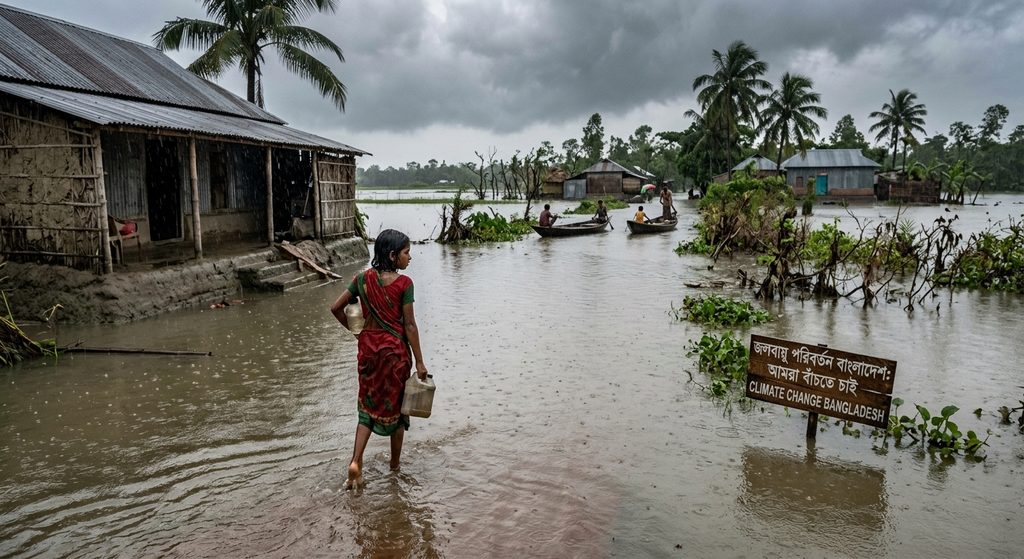
Floods and cyclones can cause damage to homes, roads, agricultural land, and other infrastructure. Changes in rainfall and weather patterns may increase the challenges associated with managing these hazards.
Sea Level Rise and Coastal Areas
Coastal Bangladesh is particularly vulnerable to sea level rise, storm surges, and saltwater intrusion. These challenges can affect drinking water, agriculture, ecosystems, and local livelihoods.
Effects on Agriculture and Food Security
Agriculture depends heavily on suitable temperature, rainfall, soil conditions, and water availability. Climate change can make farming more difficult through flooding, drought, heat, and increasing soil and water salinity in some areas.
Impact on People and Communities
Climate-related hazards can affect people’s homes, income, health, education, and access to essential services. Vulnerable communities may face greater challenges in recovering from repeated climate-related disasters.
Climate Change Adaptation in Bangladesh
Bangladesh has developed and implemented various approaches to climate adaptation and disaster risk reduction. These include cyclone shelters, early-warning systems, resilient infrastructure, coastal protection, improved agricultural practices, and community-based adaptation.
Climate-resilient development can help communities prepare for changing environmental conditions while protecting livelihoods and essential services.
Solutions to Climate Change in Bangladesh
Renewable Energy
Expanding renewable energy can help reduce dependence on fossil fuels and support a cleaner energy system.
Sustainable Agriculture
Climate-resilient crops, improved water management, better farming techniques, and appropriate agricultural technologies can help farmers respond to changing climate conditions.
Environmental Conservation
Protecting forests, wetlands, mangroves, and other ecosystems can support biodiversity while providing natural protection against some environmental hazards.
Conclusion
Climate change in Bangladesh presents significant challenges for the environment, economy, infrastructure, agriculture, and communities. Addressing these challenges requires a combination of climate adaptation, disaster preparedness, environmental conservation, sustainable development, and efforts to reduce greenhouse gas emissions.
Building climate resilience can help Bangladesh protect communities and support sustainable development in the face of a changing climate.
10. Internal Linking Strategy
Relevant internal links should be added naturally within the blog post. For example:
- Bangladesh Environment → link to an existing article about Bangladesh’s environment.
- Natural Disasters in Bangladesh → link to an article discussing floods, cyclones, and other disasters.
- Sustainable Development → link to a related article about sustainable development.
- Renewable Energy → link to an existing article about renewable energy.
Internal links should use descriptive anchor text instead of generic text such as “click here.”
11. External Linking Strategy
The article should include links to reliable and authoritative sources for supporting information, such as:
- Intergovernmental Panel on Climate Change (IPCC)
- World Bank
- United Nations Environment Programme (UNEP)
- Bangladesh government and relevant government agencies
- Bangladesh Meteorological Department
- United Nations climate-related resources
External links should be relevant to the information being discussed and should lead to trustworthy sources.
12. Image SEO Optimization
Images used in the blog should also be optimized for SEO.
Recommended Image File Names
climate-change-bangladesh.jpgbangladesh-climate-change-flooding.jpgclimate-change-coastal-bangladesh.jpgclimate-change-bangladesh-agriculture.jpg
Recommended Alt Text
- Climate Change in Bangladesh
- Flooding caused by climate change in Bangladesh
- Climate change impacts on coastal Bangladesh
- Climate change effects on agriculture in Bangladesh
Images should be compressed before uploading to reduce page loading time while maintaining acceptable visual quality.
13. On-Page SEO Checklist
| SEO Element | Optimization |
|---|---|
| Focus Keyword | Climate Change in Bangladesh |
| SEO Title | Climate Change in Bangladesh: Causes, Impacts & Solutions |
| Meta Description | Optimized with primary keyword |
| URL | /climate-change-in-bangladesh/ |
| H1 | Climate Change in Bangladesh |
| H2/H3 | Primary and related topics included |
| Keyword Usage | Natural and relevant |
| Internal Links | Relevant website pages |
| External Links | Authoritative sources |
| Image File Names | Descriptive and keyword relevant |
| Image Alt Text | Descriptive and relevant |
| Readability | Short paragraphs and clear headings |
| Content Structure | Logical H1 → H2 → H3 hierarchy |
| Keyword Stuffing | Avoided |
| User Experience | Clear, readable, and informative |
14. Final Result
After applying the above On-Page SEO techniques, the blog post “Climate Change in Bangladesh” has a clear SEO structure with a suitable focus keyword, optimized title and meta description, SEO-friendly URL, properly organized headings, relevant internal and external links, optimized images, and natural keyword usage.
The optimized structure is designed to make the content easier for both search engines and users to understand while maintaining natural, useful, and readable content.
Leave a Reply